The Gospel Coalition, founded by the well-known theologians Timothy Keller, who was also widely known in Hungary, and Canadian theologian D. A. Carson, held its biennial conference for women in Indianapolis, USA, from June 11–13. The Psalms were at the heart of the event, but our experiences and impressions can perhaps best be summed up by the statement in the title: Christianity is good, true, and beautiful.
Protestantism has played an enduring and indispensable role in the founding and rise of the United States. Since the middle of the twentieth century, however, its influence has been declining in the country. Alongside this decline, there has also been increasing fragmentation: denominational communities have divided and new ones have emerged along various theological lines. American Protestantism—as is Protestantism generally anywhere else in the world—is therefore best understood as a complex umbrella term.
Perhaps for precisely this reason, when it comes to American Protestantism, we can encounter very different conclusions in Hungary, depending on the theological perspective from which it is viewed. Some highlight liberal-progressive theological characteristics, others extreme conservatism, while still others point to one-sided support for political forces on either the right or the left. As in every case, approaching this question requires great care, humility, and commitment if we wish to form a mature opinion about the influential Christian communities of a vast country thousands of kilometers away. Just as our own situation cannot be described in black-and-white terms or reduced to a single label, neither should we attempt to do so with American Protestantism.
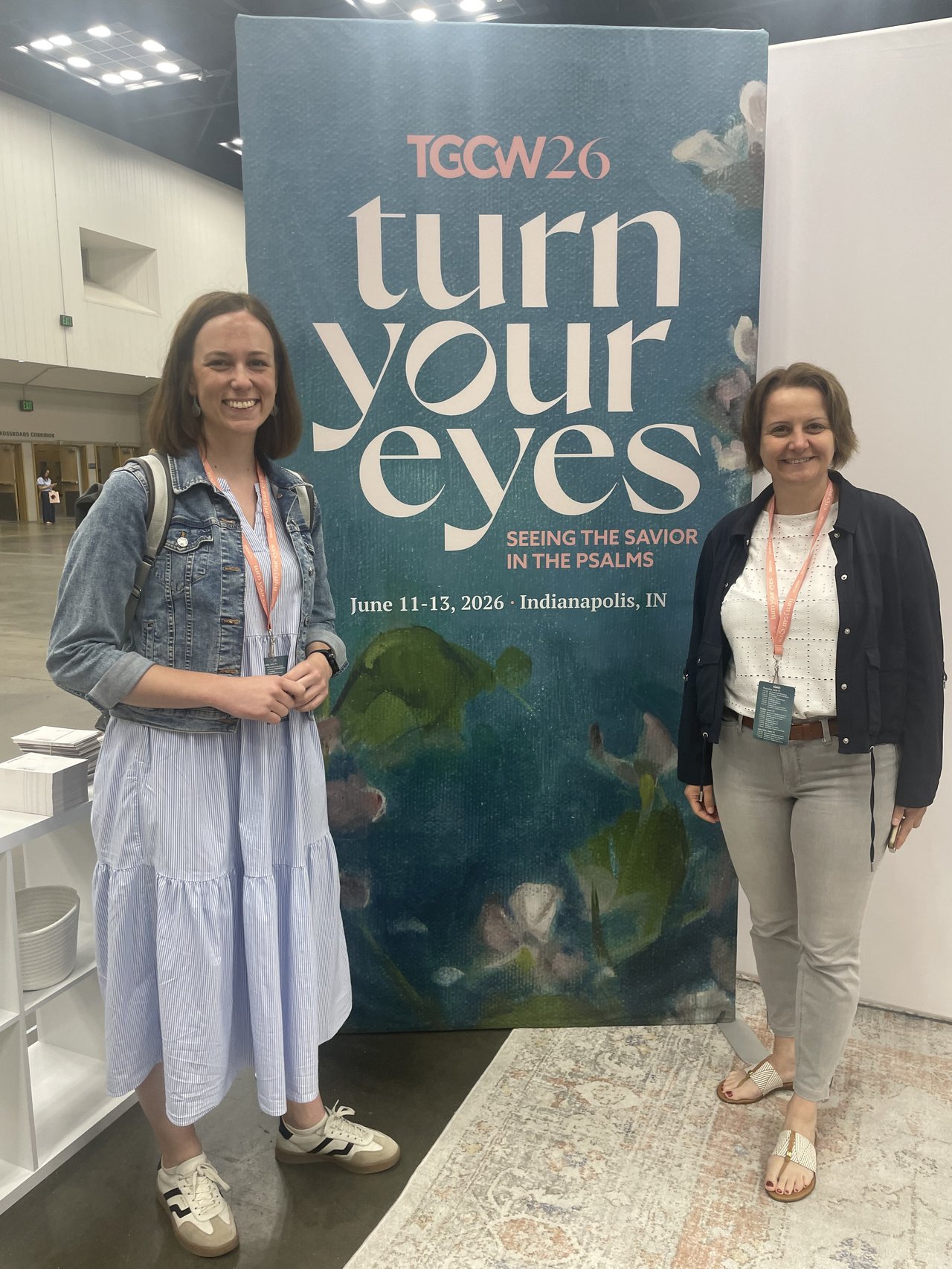
Júlia Berecz and Borbála Mikola at the conference
Rather than attempting to analyse American Protestantism as a whole, we would like to share with the wider Reformed community our experience of attending The Gospel Coalition’s conference in Indianapolis. We participated at the invitation of our American partners, together with Borbála Mikola, Director of Mission at the Mission Department of the Reformed Church in Hungary.
The Gospel Coalition (TGC) is the largest evangelical network in the United States, founded in 2007. Rather than operating through the institutional structures of national denominations—the form of cooperation perhaps more familiar to us in Hungary—it functions as a genuine network. It is a coalition of evangelical believers rooted in Reformed theology, united not primarily by nationality, culture, political affiliation, or denominational identity, but by the gospel of Jesus Christ. Its aim is “to renew the contemporary church in the ancient gospel.” Alongside seeking a deeper understanding of the gospel, it seeks to support Christians in their faith. It also considers dialogue with contemporary culture and society an important part of its mission. In other words, it seeks to show both believers and those who are distant from the Christian faith that Christianity is good, true, and beautiful.
TGC’s largest event this year was its biennial conference specifically for women. Around 8,500 women attended the three-day event in Indianapolis, coming from all fifty states of the United States. For Hungarian eyes, this was an event of an unusual scale, and it addressed a clearly defined group within the church—women—in a way that may also seem unusual to the Hungarian Reformed community. It is important to understand, however, that evangelical communities in the United States place considerable emphasis on this area of ministry (women’s ministry). Women minister to women, with a strong focus not only on bringing them to faith but also on exploring what it means to follow Christ, and to grow and mature in Christ, as women in the various circumstances and roles of life.
This ministry is particularly important today because, according to the latest research, 2025 was the first year in the history of the United States in which the proportion of women affiliated with a church declined. The reasons are varied and complex, but what seems clear is that an increasing proportion of American women are becoming alienated from the church rather than regarding it as a true home.
It may seem somewhat clichéd for someone to return from a women’s conference strengthened in the conviction that Christianity really is good, true, and beautiful. The TGC conference in Indianapolis certainly did not fail to affirm, in general terms, that being a woman is indeed a good, true, and beautiful gift from God. Yet as a Hungarian Reformed woman, I found that the conference helped me experience this far more deeply than my experiences at home. The wide variety of programmes and participating organisations presented not only the beauty and joyful gifts of womanhood, but also laid bare the incomprehensible pain that women experience and the gift and beauty of healing offered in Jesus.
The goodness, truth, and beauty of Christianity were not merely slogans. In keeping with TGC’s principles and aims, the preaching at the plenary sessions helped participants turn their eyes to Jesus through the various prayers found in the Psalms, offering biblical teaching of a depth that is rarely experienced. (The title of this year’s conference was Look to Him: Discovering the Savior in the Psalms.)
Key messages from the plenary sessions:
“He became chaff so that we could become trees planted by streams of water. This is what the Savior did for us.” — Melissa Krueger
“Gratitude does not come naturally to us; silence does. That is why we need to learn thanksgiving. Thanksgiving changes us: it softens our hearts and opens our eyes.” — Courtney Doctor
“The extent to which we experience joy and fulfillment in any circumstances is directly connected to the extent to which we are willing to turn to God in trust.” — Ruth Chou Simons
“Even in suffering, in the night of hardship, thanksgiving can still be heard. Such thanksgiving is especially precious because it costs us something.” — Joni Eareckson Tada
“There is no such thing as wasted suffering in the life of a believer. The fact that we do not understand it does not mean that it is without purpose.” — Mark Vroegop
“Apart from Bartimaeus, no one else called Jesus the Son of David; everyone else called him ‘Teacher.’ And they received nothing from him.” — Jen Wilkin
“There are two kinds of people: the rebel who has turned to the Son of God, and the rebel who needs to turn to him.” — Vanessa Hawkins
“May the passing of time not merely make you older, but make you stronger. Lean on Christ, and you will find renewed vitality, fresh joy, and life even in the driest places!” — Nancy Guthrie
Through the elective sessions, participants could grow in their understanding of topics related to Christian life and womanhood. These included how to study the Bible together or individually, what it means to proclaim the gospel, what it means to experience particular circumstances in women’s lives as Christians, and how to help and support a fellow woman in the congregation who is living through a crisis, a friend, or a fellow human being who has fallen victim to human trafficking.
Although what we experienced at the conference is not diminished by it, it would be a mistake to conclude our report without mentioning the decision made at the annual meeting of the Southern Baptist Convention (SBC) in the United States on June 10, which once again brought the question of women’s ministry in the church and local congregations into sharper focus beyond the Baptist denomination itself. In congregations belonging to the largest Baptist association in the United States—as in many other Protestant denominations—women have not previously been permitted to serve as leaders of congregations or to preach in a capacity involving the entire congregation. At the annual meeting, however, nearly 75 percent of delegates voted that, in the future, the title pastor may not be used for women in any area of ministry.
The question of women serving as pastors is particularly significant in the wider ecclesial discourse because, for many Protestants, accepting women’s pastoral ministry represents the first step towards the church moving in a “liberal” theological direction. This is not a question that forms part of the Hungarian discourse, and we do not wish to make it one. At the same time, in light of the tensions and pain surrounding this issue in the United States—which may currently be more pronounced than before—we invite everyone to pray for the credibility of Christian witness in this matter as well: in the United States, in Hungary, and throughout the world.
For we believe—and can believe—that Christianity truly is good, true, and beautiful. And this is genuinely good news in a world that is moving ever further away from goodness, truth, and beauty. It is good news both for women experiencing the many joys and pains of womanhood and for men. To proclaim this good news, we need one another—women and men, young and old, rich and poor.